
Why do couples who love each other sometimes keep having the same argument over and over again?
You may recognize the pattern.
One partner says, “Why don’t you ever talk to me?”
The other responds, “Because nothing I say is ever good enough.”
The first partner becomes more frustrated: “See? You don’t even care!”
The second partner shuts down, walks away, or becomes silent.
The more one partner reaches, the more the other pulls away. The more the other pulls away, the more desperate the first partner becomes for a response, and somehow, the couple ends up having the same fight again. In Emotionally Focused Therapy (EFT), developed by psychologist Dr. Sue Johnson, these repetitive patterns are called interactional cycles. They are the emotional dances couples can become trapped in when their sense of connection and security is threatened. The important thing to understand is this:
The cycle is the enemy—not your partner.
Most couples do not intentionally create these patterns. They develop as each person tries to protect themselves, get their needs met, or restore a sense of connection. Once a cycle becomes established, however, it can begin to feel as though your partner is the problem. EFT helps couples step back and recognize the pattern so they can begin creating a different one.
1. The Pursue–Withdraw Cycle
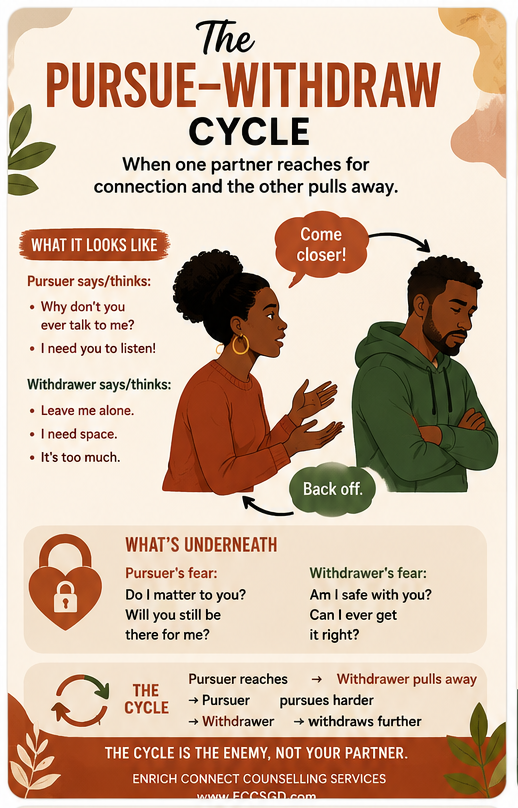
This is one of the most common negative cycles seen in couples. One partner feels disconnected, anxious, ignored, or uncertain about the relationship. They respond by pursuing the other person for reassurance, engagement, or connection.
The pursuit might look like:
-
- Asking repeated questions
-
- Complaining or criticizing
-
- Demanding attention
-
- Raising the intensity of the conversation
-
- Saying, “We need to talk!”
-
- Following the partner from room to room
-
- Becoming increasingly angry when there is no response
The other partner experiences this intensity as threatening or overwhelming and responds by withdrawing.
Withdrawal might look like:
-
- Going silent
-
- Leaving the room
-
- Avoiding the conversation
-
- Looking at a phone or television
-
- Saying, “I don’t want to talk about this.”
-
- Becoming emotionally numb
-
- Agreeing simply to end the conversation
Unfortunately, withdrawal usually makes the pursuing partner feel even more abandoned. So they pursue harder, and the more they pursue, the more the withdrawing partner retreats.
The cycle sounds like:
“Come closer!” → “Back off!” → “Why won’t you come closer?” → “Because you won’t leave me alone!”
Both partners may eventually feel completely misunderstood.
The pursuer thinks: “You don’t care enough to fight for us.”
The withdrawer thinks: “Nothing I do is ever enough, so I might as well stop trying.”
Underneath the anger and withdrawal, however, there are often deeper attachment fears:
Pursuer: “Do I matter to you? Are you still there for me?”
Withdrawer: “Am I safe with you? Can I get this right? Will I ever be enough?”
2. The Attack–Defend Cycle
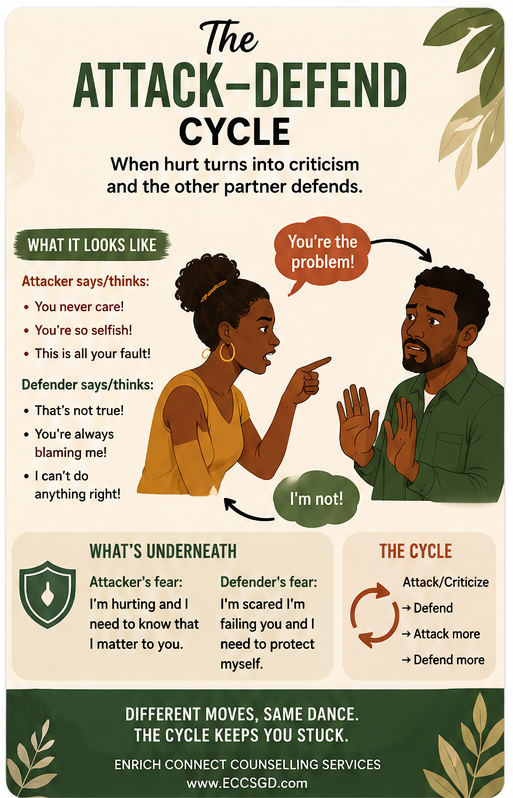
Sometimes the pursuit does not look like pleading or repeated requests. Instead it looks like attack. A partner may express their hurt through criticism, contempt, accusation, hostility, or blame.
The other partner then responds defensively:
“That’s not true.”
“You’re the one who does that!”
“I can’t do anything right with you.”
“You’re always blaming me.”
Now both partners are protecting themselves. One attacks because they feel hurt and disconnected. The other defends because they feel blamed, rejected, or threatened. The defense then confirms the first partner’s belief:
“See? You won’t listen to me.”
And the attack confirms the second partner’s belief:
“See? I’m never safe from criticism.”
The cycle continues.
What may be happening underneath?
The attacking partner may actually be saying:
“I’m hurting and I need to know that I matter to you.”
The defending partner may actually be saying:
“I’m scared that I’m failing you and I need to know that I’m still acceptable to you.”
The problem is that neither message is being communicated in its vulnerable form. The Attach-Defend cycle can also show up as Attack-Attack, where the defense may take the form of a counter attack.
3. The Withdraw–Withdraw Cycle
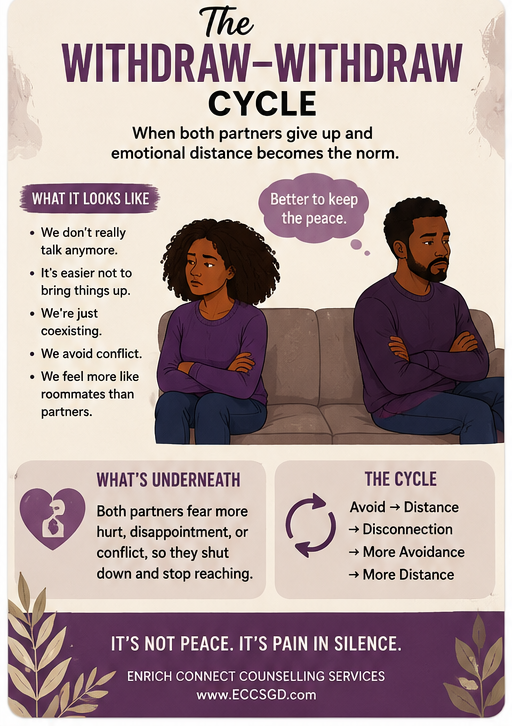
Not every couple fights loudly. Some couples become increasingly quiet. At first, withdrawal may have been a way of preventing conflict. Over time, however, both partners may stop reaching for each other. They stop arguing—but they also stop connecting. The relationship can begin to feel like two people sharing a home rather than two people sharing a life.
They may describe themselves as:
-
- “Roommates”
-
- “Distant friends”
-
- “We’re just keeping the peace.”
-
- “We don’t really talk anymore.”
-
- “It’s easier not to bring things up.”
This can be particularly difficult to recognize because there may not appear to be a problem. There is no screaming. No major arguments. No obvious conflict. But there may also be very little emotional engagement. Both partners have gradually learned: “It’s safer not to reach.” This can become a kind of emotional no-man’s-land. The couple may look peaceful from the outside while experiencing considerable loneliness on the inside.
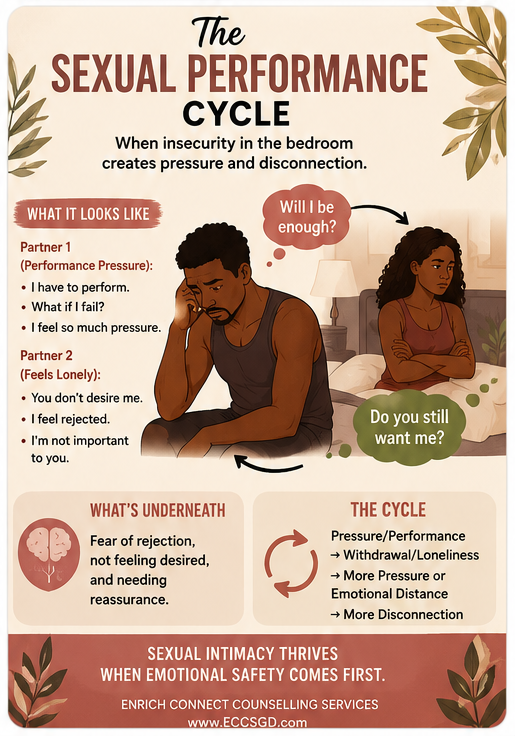
4. The Sexual Performance Cycle
Attachment cycles can also show up in a couple’s sexual relationship. Sex is not simply a physical activity in an intimate relationship. For many couples, it is also connected to feelings of desirability, acceptance, reassurance, vulnerability, and emotional connection. When attachment insecurity enters the bedroom, couples can become caught in a painful cycle.
For example, one partner may become increasingly focused on sexual performance—whether they are performing well enough, satisfying their partner, or meeting expectations. The more pressure they experience, the more difficult sexual connection may become.
The other partner may experience the withdrawal or difficulty as:
“You don’t want me.”
“I’m not attractive to you.”
“Something is wrong with our relationship.”
They may then seek more reassurance, become frustrated, or emotionally withdraw themselves. The original partner experiences even more pressure, and the cycle intensifies. What looks like a sexual problem may actually be an attachment problem playing out through sexuality.
The deeper questions may be:
“Am I desirable to you?”
“Am I enough?”
“Are you emotionally here with me?”
“Can I be vulnerable with you without being rejected?”
So Why Do These Cycles Become So Powerful?
To understand this, we have to look underneath the interaction. When we experience someone important to us as unavailable, unresponsive, rejecting, or threatening to leave, our attachment system can become activated.
We may experience an internal alarm: “Something is wrong between us.” So we instinctively try to restore connection, but we don’t all respond to that alarm in the same way. Some people reach harder. Others pull back. Some become angry. Others become defensive. Some become quiet. Others become increasingly demanding.
These responses can actually trigger the very reaction we fear and that is how the cycle becomes self-reinforcing.
The Hidden Cycle of Separation Distress
When someone important becomes emotionally unavailable, there can be a progression of emotional responses. This is what is often happening internally when the attachment behaviours aren’t getting a response.
1. Angry Protest
The first response may be protest. “Why aren’t you responding?” “Why don’t you care?” “Talk to me!”
Anger can be an attempt to get the other person to respond. It is often easier to express anger than the vulnerable fear underneath it.
2. Clinging and Seeking
If the protest does not restore connection, the person may try even harder. They may seek reassurance, repeatedly initiate conversations, send messages, ask questions, or become increasingly preoccupied with the relationship.
The underlying message may be: “Please show me that I’m important to you.”
3. Depression and Despair
If repeated attempts to reconnect continue to fail, hope can begin to disappear. The person may think: “What’s the point?” “They don’t really want me.” “Nothing I do makes a difference.”
This can lead to sadness, hopelessness, and emotional exhaustion.
4. Emotional Detachment
Eventually, a person may stop reaching altogether. This can look like acceptance, but sometimes it is actually giving up.
They may say: “I don’t care anymore.” “Do whatever you want.” “It doesn’t matter.”
But sometimes “I don’t care” actually means: “I cared for so long that I couldn’t keep hurting.”
This is why emotional detachment can be such an important signal in couples therapy.
The Good News: Couples Can Create a Different Cycle
EFT is not simply about identifying unhealthy patterns. The goal is to help couples create a new emotional dance.
Instead of: Demand → Withdraw → Pursue harder → Withdraw further
the couple begins to move toward:
Vulnerability → Responsiveness → Connection → Security
This is sometimes described in terms of accessibility and responsiveness. Partners become better able to communicate:
“I need you.” “This matters to me.” “I’m scared.” “I feel alone.” “I want to know that we’re okay.”
And instead of responding defensively or withdrawing, the other partner learns to respond with:
“I’m here.” “I hear you.” “You matter to me.” “Help me understand.”
That creates a very different kind of emotional dance.
One of the particularly powerful moments in EFT occurs when a partner who has traditionally been critical or demanding begins to express the vulnerable feelings underneath the criticism.
Instead of: “You never care about me!” the message becomes: “When you pull away from me, I get scared that I don’t matter to you.”
Instead of attacking, the person is taking an emotional risk. The other partner now has an opportunity to respond differently.
Instead of defending themselves: “That’s ridiculous. Of course I care!” they may respond: “I didn’t realize how alone you felt. I don’t want you to feel that way.”
That moment can become profoundly corrective as the couple begins to experience a new cycle. One that looks more like:
“I can reach for you—and you will respond.”
Over time, these experiences can create a greater sense of safety and security within the relationship.
The same transformation can happen sexually. Healthy sexual connection is not simply about performance. It can become a shared experience of safety, vulnerability, pleasure, affection, and connection. When partners feel emotionally secure, sex can become less about proving something and more about being present with one another.
Instead of: “Am I performing well enough?” the focus can become: “Are we connected?”
Instead of: “Do you still desire me?” the experience can become: “I feel wanted, safe, and close to you.”
This is what EFT describes as a more integrated experience of sexuality—where attachment, caregiving, and sexuality support one another. Sex becomes less of a test and more of a shared adventure.
Your Relationship Has a Cycle Too
Every couple develops patterns. The question is not whether you have a cycle.
The question is: What happens when the two of you become emotionally disconnected?
-
- Do you pursue while your partner withdraws?
-
- Do you criticize while your partner defends?
-
- Do you both shut down?
-
- Do you turn toward sex for reassurance while your partner pulls away?
-
- Or are you learning to reach for each other with greater vulnerability and respond with greater compassion?
The most important shift is learning to recognize that you are not enemies. You are caught in a cycle. Once couples can see the cycle, they can begin to step outside of it. Instead of asking: “What’s wrong with you?” they can begin asking: “What’s happening to us?” And eventually you can move towards working together to figure out what you can do differently when the cycle starts.
That is where meaningful change begins.
The Cycle Is the Enemy
Your partner may sometimes feel like the source of your frustration. You may feel that if they would just change, everything would be better, but relationships are rarely that simple. Often, both partners are responding to each other in ways that make perfect sense from within their own emotional experience, while unintentionally making the relationship less secure.
EFT invites couples to slow the dance down. To notice the pattern. To identify the vulnerable emotions underneath the reactions and to begin creating a new pattern in which both partners can experience: reaching, responding, repairing and togetherness.
Because the goal is not simply to have fewer argument but to create a relationship where both people feel emotionally safe enough to reach, respond, and remain connected—even when life gets difficult.
If you and your partner find yourselves having the same argument repeatedly, the problem may not simply be what you are arguing about. You may be caught in a cycle. Couples counselling can help you identify the pattern, understand what is happening underneath it, and begin building a more secure way of relating to one another.
Enrich Connect Counselling Services
Helping individuals and couples build healthier, more connected relationships.
www.ECCSGD.com