“You’re too sensitive.” “You’re overreacting.” “Don’t be such a baby.” “You shouldn’t feel that way.”
Most of us have heard statements like these at some point in our lives. They may seem harmless or even well-intentioned, but when these messages are repeated over time, they can have a profound impact on how we view ourselves, regulate our emotions, and relate to others. According to psychologist Dr. Marsha Linehan, the developer of Dialectical Behavior Therapy (DBT), one of the most significant contributors to chronic emotional distress is living in an invalidating environment. While all of us experience occasional invalidation, persistent invalidation can quietly shape our emotional development in ways we may not recognize until adulthood.
Understanding invalidation can help us make sense of why we struggle to trust ourselves, why some relationships feel exhausting, and why certain emotional wounds seem so difficult to heal.
What Is Emotional Invalidation?
Emotional invalidation occurs when another person dismisses, ignores, judges, minimizes, or rejects our internal experience. Notice that invalidation is about our experience, not necessarily the facts of a situation.
Imagine a child saying, “I’m scared.” A validating response might be: “I can see you’re frightened. Tell me what’s making you feel that way.” An invalidating response however, might be: “There’s nothing to be afraid of.”
The child’s fear doesn’t disappear simply because someone says it shouldn’t exist. Instead, the child learns something very different:
“Maybe my feelings are wrong.”
Over time, this lesson can become deeply ingrained.
What Does Invalidation Look Like?
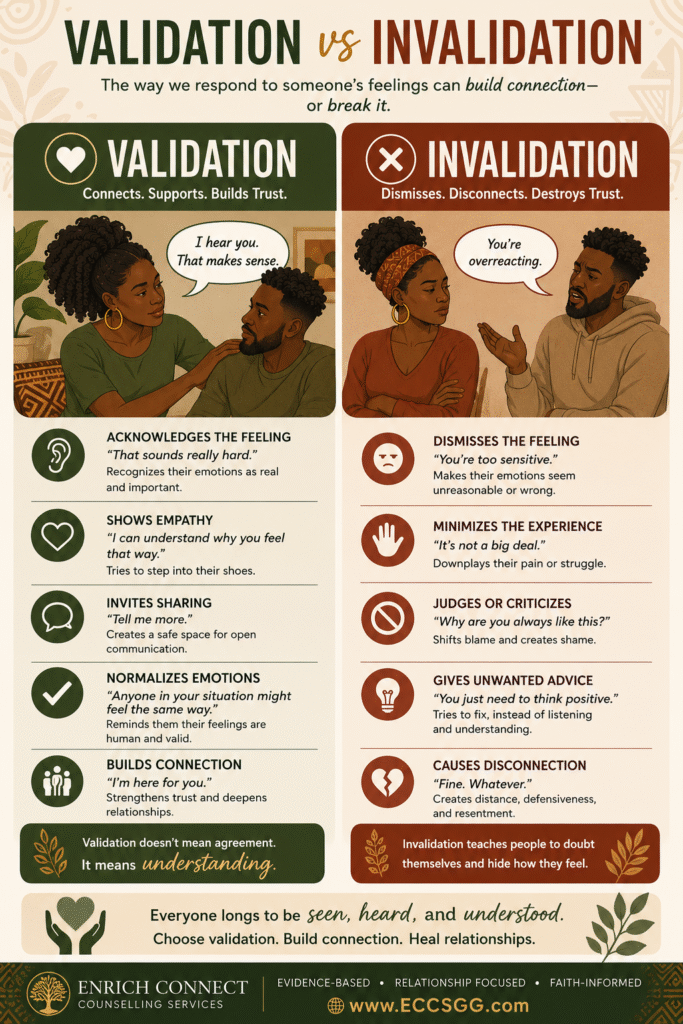
Invalidation isn’t always harsh or abusive. Often, it appears in subtle, everyday interactions. Some common examples include:
-
- “You’re overreacting.”
-
- “Stop being so sensitive.”
-
- “Other people have it much worse.”
-
- “Just get over it.”
-
- “You’re making a mountain out of a molehill.”
-
- Ignoring someone’s emotional expression altogether.
-
- Punishing someone for expressing sadness, fear, or anger.
-
- Only responding once emotions become extreme.
Sometimes invalidation is unintentional. Parents may believe they are helping children become “strong.” Partners may try to solve problems instead of listening. Friends may minimize pain because they feel uncomfortable. Intent matters, but so does impact. The reality is that repeatedly feeling unseen or misunderstood can leave lasting emotional scars. Now it’s also important to note that though invalidation tends to be mostly painful, there are times when it may be helpful. Linehan points out that invalidation is occasionally helpful when it corrects factual mistakes (e.g., “Your facts are wrong”) or stimulates intellectual growth through respectful debate but in such cases context, relationship and how it is done matters.
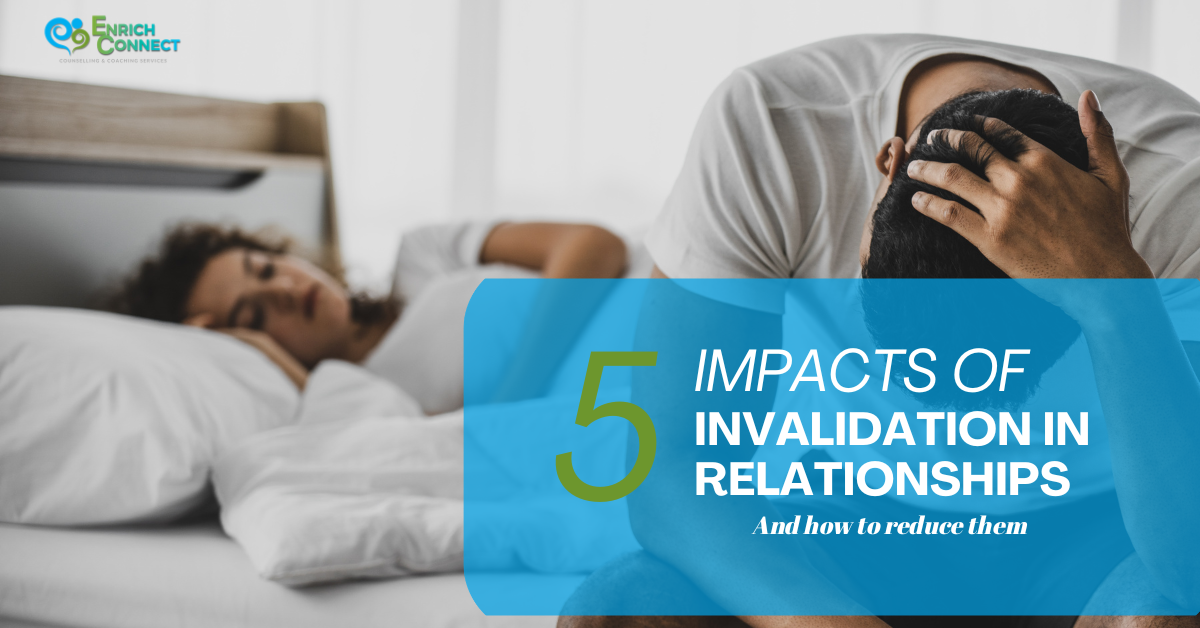
1. Invalidation Hurts
Human beings are wired for connection. Long before we could speak, our survival depended on caregivers recognizing our cries, interpreting our needs, and responding appropriately. Our nervous systems still depend on this process. When our emotions are acknowledged, our brains receive a powerful message: “I am seen.” When our emotions are repeatedly dismissed, we receive a different message: “My inner experience doesn’t make sense.”
This doesn’t simply create disappointment. It creates uncertainty. Instead of trusting our own emotions, we begin questioning them.
2. Invalidation Changes the Way We See Ourselves
One of the most major consequences of persistent invalidation is the gradual loss of self-trust. Instead of asking, “What am I feeling?” we begin asking, “What should I be feeling?” Instead of trusting our own judgment, we constantly look to others for reassurance that our reactions are acceptable.
Over time, people may begin to experience:
-
- chronic self-doubt
-
- insecurity
-
- people-pleasing
-
- dependence on external approval
-
- difficulty making decisions
-
- uncertainty about their own identity
Rather than developing confidence in their internal experiences, they become dependent on external validation to determine what is “right.” This is one reason people who have experienced chronic invalidation often describe feeling disconnected from themselves.
3. It Reinforces Difficult Emotions
Dr. Linehan’s Biosocial Theory proposes that some individuals are biologically more emotionally sensitive than others. They experience emotions more intensely, react more quickly, and take longer to return to baseline. This emotional sensitivity is not a character flaw.
However, when emotionally sensitive individuals repeatedly grow up in environments where their feelings are dismissed or criticized, they often fail to learn healthy ways of understanding and regulating those emotions. Instead, emotions become confusing, overwhelming, or even frightening. This is one pathway to what psychologists call emotion dysregulation.
4. It creates Unhealthy Response Patterns
People often respond to chronic invalidation in one of two ways.
1. They become louder.
If quiet expressions of emotion are ignored, people naturally increase the intensity of their communication. They cry harder. They argue more forcefully. They become increasingly desperate to be understood. This is not necessarily attention-seeking. More often, it is connection-seeking. When our emotional signals fail to reach others, our nervous system instinctively turns up the volume.
2. They become quieter:
Other people learn the opposite lesson. “If my feelings are always wrong, perhaps I shouldn’t have them.” These individuals suppress emotions, withdraw from conflict, avoid asking for help, and may eventually feel emotionally numb.
Although these two responses appear very different, both grow from the same root: Neither person learned that their emotions were safe to express.
5. Invalidation Damages Relationships
Now this is a very important consideration for parents and partners. One of the most painful consequences of invalidation is the cycle it creates within relationships.
Imagine one partner expressing hurt but instead of feeling understood, they feel dismissed. What would naturally follow is a repetition of themselves but with greater emotion. Then the other partner experiences this as criticism or overreaction and becomes defensive or withdraws. Feeling even less understood, the first partner intensifies further.
Without realizing it, both people become trapped in a cycle where each person’s attempt to protect themselves makes the other feel even more invalidated. Over time, trust erodes and communication becomes increasingly difficult. Furthermore, some relationships become marked by escalating conflict, while others become painfully silent.
In both cases, emotional safety is lost.
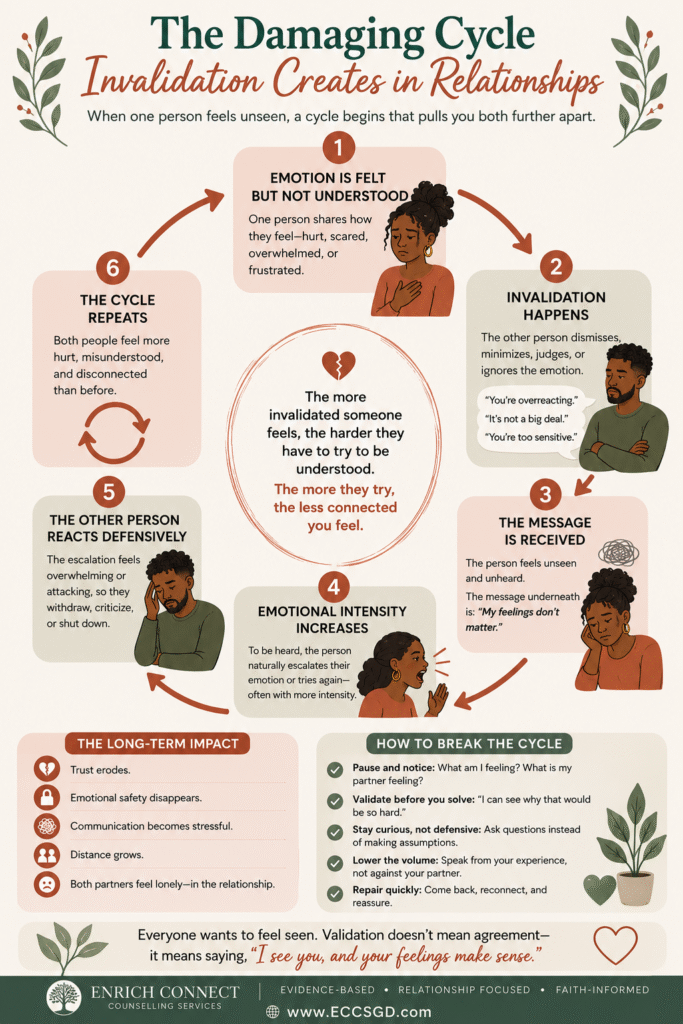
What Validation Makes Possible
One of the greatest misconceptions about validation is that validating someone means agreeing with everything they say. It doesn’t. Validation simply communicates that another person’s emotional experience makes sense in light of what they have experienced.
For example: “I can understand why you felt hurt after hearing those words.”
This validates the person’s emotional experience. It does not necessarily mean you agree with their interpretation, their conclusions, or their behaviour. Healthy relationships make space for both empathy and honest disagreement.
Validation does something remarkable. When people genuinely feel understood, their nervous system begins to settle and defensiveness decreases. The Gottman’s point out that defensiveness is one of the most destructive relationship patterns in a relationship, one can see why when considering how it affects one’s sense of safety. Further to this, validation makes problem solving easier, makes room for more open communication and grows trust.
Ironically, people often become less emotionally reactive once they no longer have to fight to prove that their emotions exist. Feeling understood creates the safety necessary for emotional regulation to happen and from as early as the toddler stage of development to older adulthood, everyone just wants to feel safe.
Many people spend years wondering, “Why am I so emotional?” Sometimes a more helpful question is, “How often were my emotions welcomed?” this isn’t just a cognitive behavioural lens but an attachment one, one that helps better understand the impact of specific behaviour patterns on a person’s emotional and relational development.
Emotional invalidation does not mean someone is weak, broken, or beyond healing. It means their internal world has repeatedly been misunderstood or dismissed. The encouraging news is that validation can become a corrective emotional experience. Whether it comes from a trusted friend, a caring partner, a therapist, or even the gradual practice of validating ourselves, learning that our emotions can be acknowledged without being judged helps rebuild something invalidation slowly erodes; which is our ability to trust ourselves.
Healing begins when we discover that our emotions don’t have to be perfect to be worthy of understanding. They simply need to be heard.
Lorem ipsum dolor sit amet, consectetur adipiscing elit. Ut elit tellus, luctus nec ullamcorper mattis, pulvinar dapibus leo.